

Home Design Article
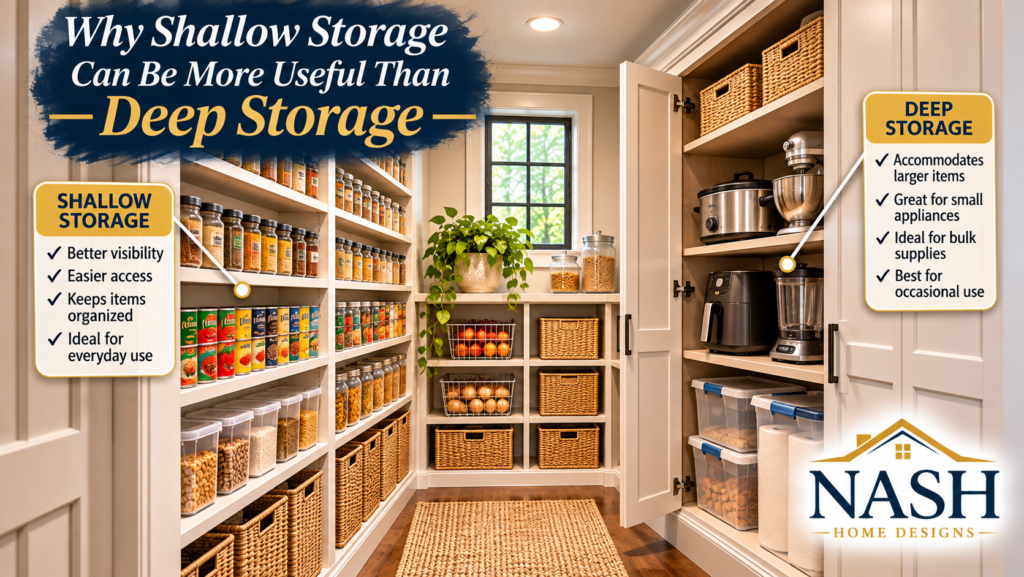
Why Shallow Storage Can Be More Useful Than Deep Storage
Discover why shallow storage can be more practical than deep cabinets and closets. Learn smart ways to improve organization, accessibility, and home design.
Why Shallow Storage Can Be More Useful Than Deep Storage
Designing Smarter Storage Spaces That Make Everyday Living Easier
When designing a new home, homeowners often assume that bigger and deeper storage spaces are always better. Whether it’s a pantry, linen closet, bathroom cabinet, or utility room, the natural tendency is to maximize the available depth to accommodate as much storage as possible.
But deeper storage doesn’t always mean more useful storage.
In fact, a well-designed shallow cabinet or closet can sometimes be considerably more functional than a much deeper space.
The reason is simple: storage is only truly valuable when you can easily see, reach, and retrieve the items inside it.
At NASH Home Designs, we believe efficient residential design isn’t just about providing more square footage. It’s about making every square foot work better for the people who live in the home.
More Storage Space Doesn’t Always Mean Better Organization
Consider a typical deep pantry shelf.
Items placed near the front are easy to see and retrieve, but those stored toward the back can quickly disappear behind other products.
Before long, homeowners may find themselves moving several containers just to reach something they know is somewhere on the shelf.
The same problem frequently occurs in deep linen closets, bathroom cabinets, and household storage areas.
Items become stacked behind one another, making it difficult to maintain an organized system.
This can lead to forgotten supplies, duplicate purchases, and unnecessary clutter.
The goal of good storage design should be to maximize usable storage, not simply the total volume of available space.
Shallow Pantry Shelves Can Improve Everyday Convenience
The kitchen pantry is one of the best examples of why shallow storage can be beneficial.
Traditional pantry shelves are sometimes designed 18 to 24 inches deep, which may be appropriate for certain larger items but unnecessarily deep for everyday food storage.
For canned goods, spices, jars, and packaged foods, shallower shelves often provide much better visibility.
Consider these general planning guidelines:
- 6–8 inches deep: Useful for spices, small jars, and canned goods.
- 10–12 inches deep: Suitable for many everyday pantry items, boxed foods, and containers.
- 14–16 inches deep: Helpful for larger containers, small appliances, and bulk food storage.
- 18–24 inches deep: Better reserved for oversized items or storage systems incorporating pull-out shelves.
These are general recommendations rather than fixed standards. Actual shelf depths should be based on the dimensions of the items being stored.
By using shallower shelving where appropriate, homeowners can often see nearly everything at a glance.
This makes grocery organization easier and reduces the frustration of searching through crowded shelves.
Linen Closets Don’t Always Need to Be Deep
Linen closets are another area where excessive depth can reduce convenience.
A deep linen closet may seem desirable because it offers more storage capacity. However, towels, sheets, and blankets often end up stacked in multiple rows.
Items placed toward the back become difficult to reach, particularly on upper shelves.
In many situations, shelves approximately 14 to 18 inches deep can accommodate neatly folded towels and linens while keeping them accessible.
Larger comforters and bulky bedding may require deeper shelving.
The key is to consider how linens will be folded, stacked, and retrieved rather than automatically using the deepest closet possible.
Adjustable shelving can also make a linen closet more versatile as household storage needs change.
Bathroom Storage Benefits From Better Visibility
Bathroom cabinets frequently contain numerous small items, including toiletries, medications, grooming supplies, and cleaning products.
When these belongings are stored inside deep cabinets, it can become difficult to locate individual items.
Shallow cabinetry can provide a more organized solution.
For example, a recessed medicine cabinet or shallow wall cabinet can keep frequently used items visible and accessible.
Similarly, narrow pull-out cabinets may provide practical storage for bottles, grooming products, and other household necessities.
In smaller bathrooms, carefully designed shallow storage can also help preserve valuable floor space.
However, recessed cabinets should only be installed where wall framing, plumbing, electrical wiring, and structural conditions permit.
Consider Shallow Storage in Hallways and Transitional Spaces
One of the greatest opportunities for shallow storage is found in hallways and other transitional areas.
These spaces are primarily used for circulation, so adding large cabinets can make them feel crowded.
However, a shallow built-in cabinet may provide valuable storage without significantly affecting the usability of the space, provided adequate circulation width is maintained.
For instance, a hallway might include shallow cabinetry for:
- Board games and family activities.
- Extra household supplies.
- Books and small decorative items.
- Seasonal accessories.
- Cleaning products.
- Everyday personal belongings.
When designed with flush or recessed cabinet doors, these storage features can blend naturally into the surrounding architecture.
It’s important to remember that applicable building codes establish minimum hallway widths. Any proposed cabinetry must preserve the required unobstructed circulation space.
Shallow Storage Can Make Small Rooms Feel Larger
In rooms where space is limited, cabinet depth can have a significant impact on how the room feels.
A deep cabinet may consume valuable floor area, making it harder to move comfortably around furniture or through a passageway.
Shallower cabinetry can sometimes provide sufficient storage while preserving more usable space.
This is especially helpful in laundry rooms, mudrooms, home offices, and smaller bathrooms.
For example, a wall of 12-inch-deep storage cabinets may provide useful space for cleaning supplies, household products, and smaller belongings without extending as far into the room as conventional base cabinetry.
The appropriate depth depends on what is being stored and how the space will function.
A little additional floor clearance can make a noticeable difference in everyday comfort.
Deep Storage Still Has Its Place
Although shallow storage offers many advantages, there are situations where deeper storage is necessary.
Large appliances, oversized containers, luggage, comforters, and bulk household supplies often require greater cabinet or closet depth.
Deep storage can also work particularly well when combined with pull-out drawers, sliding shelves, or other organizational hardware.
For example, a 24-inch-deep cabinet with full-extension drawers may provide excellent accessibility because the contents can be brought forward rather than requiring someone to reach into the back.
Similarly, deep kitchen base cabinets are often practical when designed with pull-out trays or drawers.
The important distinction is that depth should be determined by the intended contents and how those contents will be accessed.
Consider Drawers Instead of Deep Shelves
One of the most effective ways to improve deep storage is to replace conventional fixed shelving with drawers or pull-out systems.
When a drawer opens fully, stored items can become visible and accessible without requiring someone to reach into the back of the cabinet.
This approach is particularly useful for kitchen base cabinets, pantry storage, bathroom vanities, and laundry room cabinetry.
However, drawers also require proper planning.
The full extension of a drawer should not obstruct nearby doors or create circulation problems.
The cabinet hardware and drawer construction should also be appropriate for the weight of the stored items.
When selected carefully, pull-out storage can make deeper cabinets much more functional.
Think About What You Will Actually Store
Before determining the depth of any cabinet or closet, it’s helpful to identify the items that will occupy the space.
For example, if a pantry will primarily contain canned foods and boxed groceries, shallow shelving may be ideal.
If the same pantry must accommodate large countertop appliances, bulk containers, or oversized serving dishes, some deeper storage will likely be needed.
Likewise, a hallway cabinet intended for board games may require a different depth than one intended for cleaning products.
By considering the actual dimensions of the stored items, homeowners can make more informed design decisions.
This approach often results in storage that’s easier to organize and more enjoyable to use.
Use Different Shelf Depths in the Same Space
One particularly effective strategy is incorporating multiple shelf depths within a single storage area.
A walk-in pantry, for example, might feature shallow shelving along one wall for canned goods and packaged foods.
Another wall could provide deeper shelving for small appliances, bulk storage containers, and larger household items.
Similarly, a linen closet might incorporate shallower shelves for towels and deeper shelves for comforters or bulky blankets.
This combination allows the storage area to accommodate different needs without sacrificing accessibility.
The goal is not to make every shelf shallow, but to provide the appropriate depth for each intended use.
Plan Storage Dimensions During the Design Process
One of the greatest advantages of designing a new home is the opportunity to consider storage dimensions before construction begins.
The depth of a pantry, linen closet, or utility cabinet can influence the arrangement of surrounding rooms and circulation areas.
For example, a carefully designed shallow pantry might provide sufficient storage while allowing additional space for the kitchen or an adjacent hallway.
In another situation, reducing cabinet depth could improve the clearance around a laundry room door or make a narrow utility space easier to use.
These small adjustments can improve functionality without necessarily increasing the overall square footage of the home.
By evaluating storage needs during the floor plan design process, homeowners can create spaces that are both efficient and comfortable.
Good Storage Design Is About Accessibility
A large closet filled with poorly organized belongings may offer less practical value than a smaller, carefully designed storage space.
When stored items are visible, accessible, and easy to return to their proper locations, homeowners are more likely to maintain an organized environment.
Shallow shelving can help accomplish this by reducing the need to reach behind other belongings or move multiple items to find what is needed.
Of course, there is no single cabinet depth that works for every situation.
The best storage solutions often combine shallow shelves, deeper compartments, drawers, and adjustable shelving to accommodate different household needs.
Thoughtful Planning Makes Every Inch Count
Storage is one of the most important considerations in residential design, but providing more storage volume isn’t always the answer.
Sometimes the better solution is to reconsider how the storage will actually be used.
By incorporating appropriately sized shelves, cabinets, and closets, homeowners can create spaces that are easier to organize, more accessible, and better suited to everyday life.
At NASH Home Designs, we believe a well-designed home should provide more than attractive rooms and generous square footage. It should incorporate practical details that make daily living more convenient.
Whether you’re designing a new home or modifying an existing floor plan, considering the depth of your storage areas can make a lasting difference in how well your home functions.
Remember, the best storage isn’t necessarily the deepest or the largest. It’s the storage that makes everything easier to find, reach, and use.
Planning a New Home or Modifying an Existing Floor Plan?
NASH Home Designs can help you evaluate practical storage solutions, efficient room arrangements, and thoughtful floor plan modifications that improve the functionality of your home.
From pantry layouts and linen closets to built-in hallway cabinetry, proper planning can make every square foot more useful.
Architectural design is our passion, but customer service is our priority.
NASH Home Designs